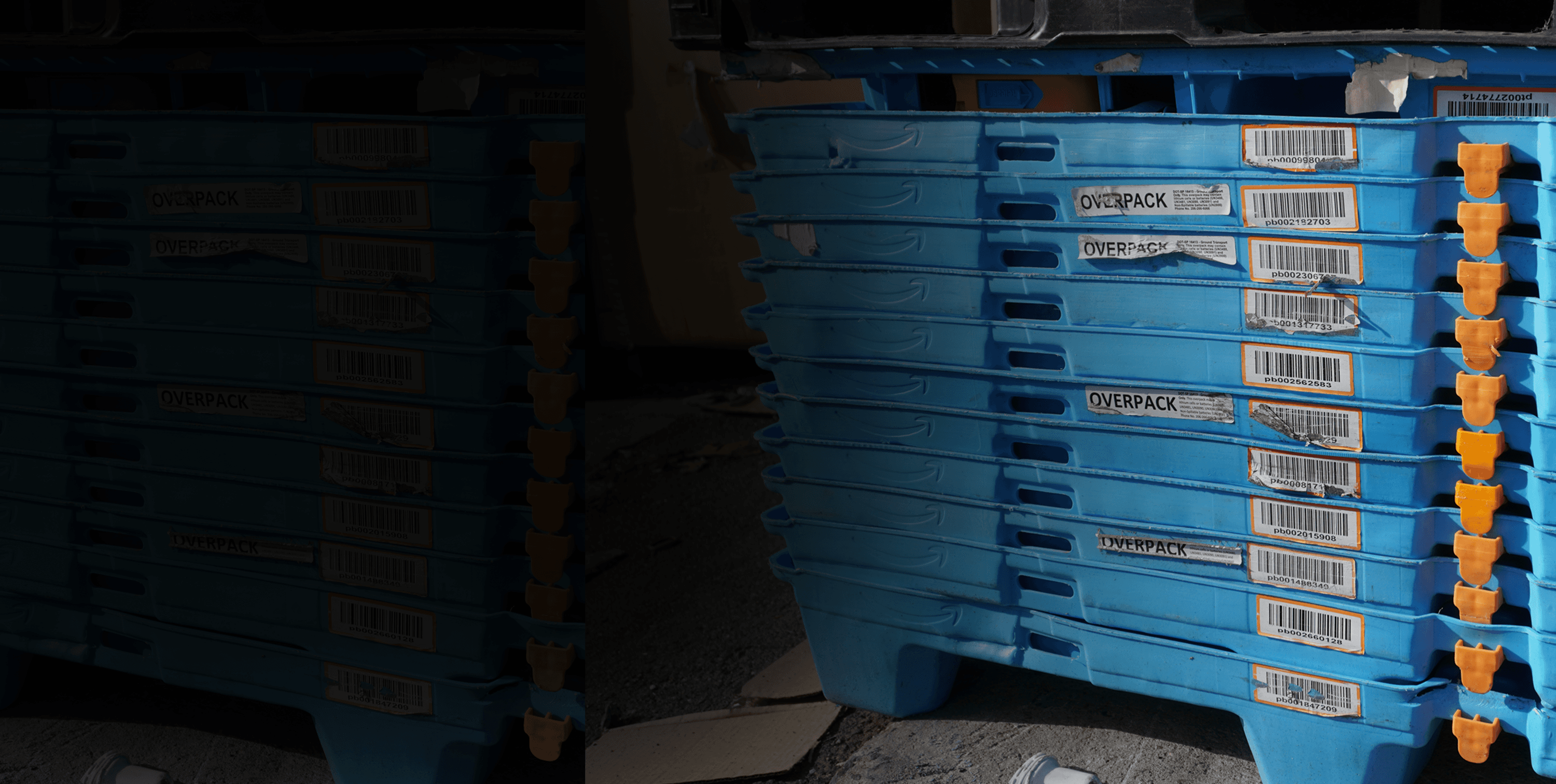
WHY GRAPHICS FAIL
Labels Were Never Designed for Plastic.
No one designed a three-cent label to last as long as a rotomolded product.
Traditional labels are expected to remain attached to materials engineered to resist attachment. When the product is built to last, its graphics cannot remain the weakest layer.
START WITH THE MATERIAL
The qualities that make polyethylene and polypropylene durable also make them difficult surfaces for conventional graphics.
01
Made to resist exposure.
Moisture, chemicals and everyday wear are part of the product’s working life.
02
Made to move in service.
The plastic expands, contracts and flexes through handling, washing and temperature changes.
03
A demanding surface for graphics.
Adhesive labels and printed inks must keep their grip through every movement and exposure.

REAL EXPOSURE. CUMULATIVE DAMAGE.
A graphic can look right at delivery and still fail long before the product does.
01
The bond weakens.
Adhesives weaken. Corners lift. Dirt and moisture collect at the edges.
02
The surface wears.
Handling and abrasion wear away print. Protective layers can crack.
03
The message fades.
UV, chemicals and repeated washing erode contrast and legibility.
04
The function goes.
Barcodes stop scanning. Instructions disappear. Identity becomes uncertain.
THE PRODUCT’S LIFE SHOULD NOT OUTLAST ITS INFORMATION.

THE SCIENCE BEHIND THE FAILURE
For an adhesive to bond, it must wet the surface. Low-surface-energy plastics resist that contact. A label that works on metal, glass or cardboard may behave very differently on HDPE or polypropylene.
THE PRACTICAL QUESTION
Was the graphic specified for this plastic—or just for a surface?
SAME LABEL. DIFFERENT SURFACES.

Lower surface energy makes conventional adhesive bonding more challenging.
MORE THAN A COSMETIC PROBLEM
The cost is determined by the job the graphic performs—not the price of the label.

SAFETY + USE
Instructions disappear.
Warnings, operating instructions and compliance markings must remain readable.
The result: uncertainty, inspections and avoidable risk.

IDENTITY + DATA
A scan becomes a stop.
Serial numbers, barcodes and QR codes connect a product to tracking and service information.
The result: manual entry, rescanning and incomplete records.

BRAND + OPERATIONS
Confidence wears away.
Faded branding and damaged graphics can undermine a product that still works perfectly.
The result: complaints, relabeling, rework and lost time.

BUILT FOR ROTOMOLDERS
Permanent graphics should work with the material, the production process and the conditions the product will face.





























MATCH THE TEST TO THE JOB
A passing adhesion test answers one question. A useful specification asks whether the graphic will keep doing its job on this product, in its actual environment.
01
THE MATERIAL
Start with the actual part.
Test on the real resin, texture and production surface. A result on glass or metal cannot answer the same question for polyethylene.
02
THE EXPOSURE
Put working life into the test.
Define UV, abrasion, chemical contact, cleaning and temperature cycling around the conditions the product will face.
03
THE RESULT
Measure the job—not just the bond.
After exposure, assess the required branding, warning legibility, identification and scanning performance against clear acceptance criteria.
WHERE DOES FAILURE BEGIN?
PRESSURE-SENSITIVE LABELS
At the adhesive interface: check edge lift, plastic compatibility and bond durability.
SURFACE PRINTING
At the printed surface: check ink adhesion, wear, chemicals and retained readability.
HOT STAMPING
At the transferred decoration: check wear and environmental exposure.
ADHESIVE IN-MOLD LABELS
Across the label construction: check the interface, materials and service conditions.
MIGS PERMANENT GRAPHICS
At the finished-product level: validate integrated graphics against the same real-world specification.
ADHESION VERSUS COHESION
MIGS integrates compatible graphic materials with the plastic during molding or through controlled heat and pressure after molding—without a pressure-sensitive adhesive.

TRADITIONAL SURFACE GRAPHICS
The crate survives. The message wears away.
Look at the Mountain Dew and Pepsi branding: large areas of the surface graphics have worn away. Fine identification text and code details are damaged too. The reusable plastic crate remains useful, but its graphics are losing the information they were meant to carry.

MIGS PERMANENT GRAPHICS
Worn plastic. Graphics still doing their job.
The scratches show the wear these crates have taken. Yet the Pepsi and Mountain Dew branding, ownership information, QR codes and tap prompts are still there. The graphic continues to support branding, identification, tracking and access to information—even as the plastic shows its working life.
THE DIFFERENCE IS NOT WHETHER THE CRATE SHOWS WEAR. IT IS WHETHER THE GRAPHICS STILL DO THEIR JOB.
BUILD THE REQUIREMENT BEFORE THE GRAPHIC
A useful specification connects the product, the exposure and the evidence. Start with these three decisions.
01
WHAT IS IT FOR?
Define the product.
Material and surface
Graphic purpose and information
Application method and placement
02
WHAT WILL IT FACE?
Define the exposure.
Operating environment
Expected service life
Readability and scanning requirements
03
HOW WILL YOU KNOW?
Define success.
Relevant test methods
Measurable acceptance criteria
Inspection and validation plan
SPECIFY THE JOB. VALIDATE THE RESULT.